
Summarized from:
Fabrizio Pregadio, The Taoist Tradition: An Introduction to Teachings, Schools, and Practices
Golden Elixir Press
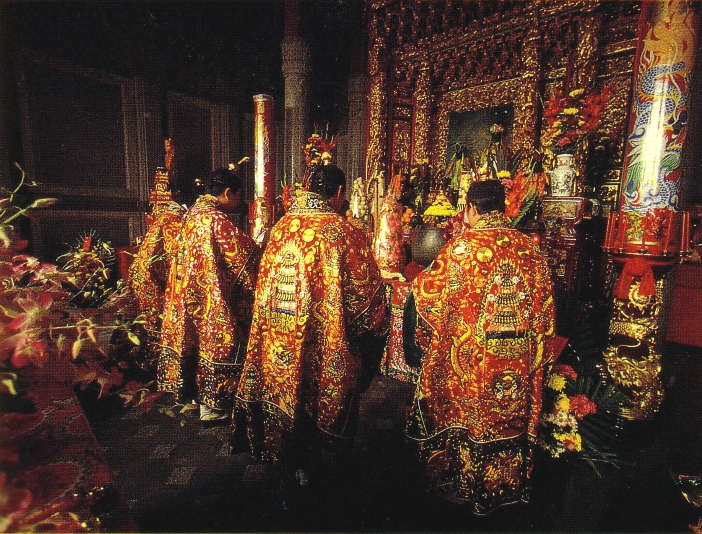
The cosmos generated by the Dao, and the heavens inhabited by deities that personify the Dao or some of its aspects, take an intermediate position between the Dao and the human world. These two domains overlap to a significant extent, for deities and features of the cosmos often correspond to one another. Both play essential roles in the various ways that Taoism provides for "returning to the Dao" (huandao), addressed to single individuals or to the community as a whole.
Correlative Cosmology
The features and workings of the cosmic domain are explicated in Taoism through the language and images of the standard Chinese cosmological system. This system, usually called "correlative cosmology," is based on several patterns of emblems (xiang) such as Yin and Yang, the five agents (wuxing), and the eight trigrams of the Book of Changes (Yijing). These emblems function as abstract categories to which any entities or phenomena can be assigned. The five agents, for instance, represent the modes or states taken on by the One Breath (yiqi) of the Dao in the cosmos, represented by Wood, Fire, Soil, Metal, and Water.
Directions of space, segments of time cycles, numbers, colors, planets, internal organs of the human body, musical notes, and so forth are assigned to one of those emblematic categories in order to define the relations that occur among the elements of a series, as well as those that occur among the different domains. Wood, for instance, is associated with the east, spring, the numbers 3 and 8, the color green (or blue), Jupiter, the liver, and the musical note jiao.
As a result, an individual entity or phenomenon is understood not only per se, but especially in light of its relation to other entities and phenomena. What something “is” is determined by the place it occupies among all other things, and by how it relates to them. An important corollary to this view is that an event or action happening or performed in one domain may affect the corresponding components in another domain according to the principle of "stimulus and response" (ganying), by which things of the same "category" (lei) influence one another.
Function in Taoism
The Taoist Tradition: An Introduction to Teachings, Schools, and Practices
A concise but comprehensive introduction to Taoist thought and religion
Correlative cosmology, which took shape as a comprehensive system between the third and the second centuries BCE, is not specifically tied to Taoism or to any other intellectual or religious legacy. It is the result of a collective effort to create a comprehensive analytic and synthetic system with contributions by thinkers and by specialists of various traditional sciences, including diviners, astronomers, and physicians. Taoism is one of several traditions — divination and classical medicine are two other major examples — that have drawn upon this system to formulate their views and to frame their techniques or practices.
In Taoism, correlative cosmology serves not only to explicate the functioning of the cosmos, but also to illustrate the view that all entities and phenomena ultimately originate from the Dao, and that the different forms in the world of multiplicity are contained within the principle of the Unity. At the same time, the emblems of correlative cosmology serve to regulate the process of "returning to the Dao" through the support of a microcosmic framework — the ritual area, the alchemical laboratory, or the human being itself. The ritual area, for instance, is arranged so as to correspond to the cosmos and its temporal and spatial configurations. In alchemy, the stages of the compounding of the elixir reproduce in a reverse sequence the cosmological configurations that intervene between the Dao and the domain of relativity.
 See an article on macrocosm and microcosm in Taoism.
Communicating with the Gods
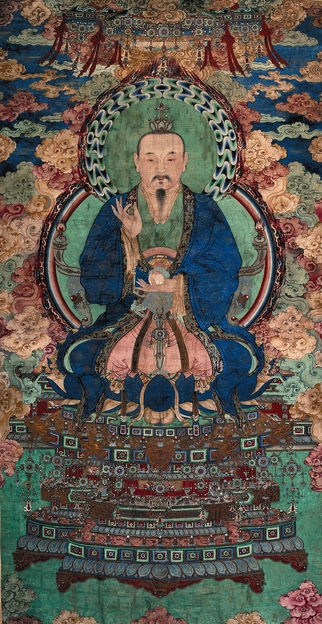
The highest Taoist deities are the Three Clarities (sanqing), each of whom rules over one of the multiple heavens distinguished in Taoist cosmography. They are associated with different pre-cosmic eras and are at the origins of the textual corpora of the Three Caverns — in other words, of the Taoist Canon.
The unity of the cosmos is represented in a deified form by the Great One (Taiyi). He resides at the center of the cosmos in the North Pole, in turn symbolically equivalent to the Northern Dipper (beidou), whose apparent rotation around its own axis distributes the Original Breath of the Dao through the sectors of space and the cycles of time. Several other gods, such as the "emperors" of the five directions, also represent cosmological principles. In addition, a multitude of deities, most of whom are the expression of local cults, contribute to form a pantheon with indefinite boundaries that takes different forms in different places and times.
Writing
The highest gods, or their representatives, reveal texts, teachings, and practices. The scriptures belonging to the Shangqing and Lingbao corpora are deemed to have taken shape from graphs coagulated from Original Breath, or from sounds generated by its vibration, in the early stages of the formation of the cosmos. Those graphs constitute the prototypes of the revealed scriptures, which at first are transmitted from one god to another, then undergo various stages of materialization, and finally are revealed to humans by a divine being or an "immortal".
Just like the gods grant revelations mostly in the form of scriptures, the typically Taoist form of communicating with the gods is by writing. In Taoist ritual, the priest delivers a "memorial" (or "statement," shu) to the deities to announce that a ceremony will be performed in their honor, declare the purpose of the ceremony, specify its program, and list the names of the sponsors. The so-called talismans (fu, a word almost exactly corresponding to Greek symbolon) are traced on paper, wood, or other supports (including air) in graphs almost incomprehensible to humans but intelligible to the gods. Like the revealed scriptures — some of which, in fact, are deemed to have evolved from them — the talismans have counterparts in Heaven, and thus serve to identify and authenticate their possessor. Talismans confer power to summon certain deities and to control demons, but they also protect space and heal illnesses; they are worn on one's body, affixed at the four directions, placed along the path that leads to one's dwelling, or made into ashes and drunk with water.

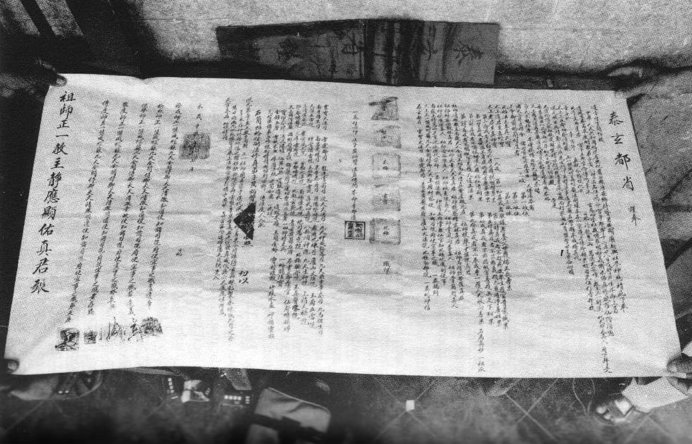
Another important ritual object in written form is the "register" (lu), a document that the Taoist priest receives at various stages of his ordination. It defines his rank, the rites that he may perform, and the deities and spirits over which he has control.
Next: 5. The Human Being ▶
© Golden Elixir Press
Illustration of Taoist ritual reproduced from Noguchi Tetsurō et al., eds., Dōkyō jiten [Encyclopedia of Taoism] (Tokyo: Hirakawa shuppansha, 1994).