
Summarized from:
Fabrizio Pregadio, The Taoist Tradition: An Introduction to Teachings, Schools, and Practices
Golden Elixir Press
The ordinary Western understanding of the body as physical frame or structure cannot convey the complexity of the premodern Chinese view. This view revolves around three main terms.
Body, Form, Person
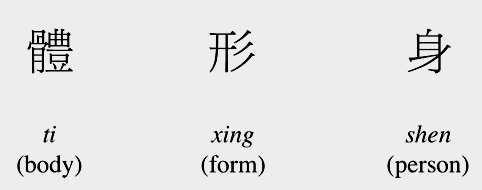
The first term, ti 體, or “body,” refers to the corporeal frame as an ordered whole made of interdependent parts; it denotes the physical body made of skin, flesh, limbs, bones, muscles, tissues, vessels, and all other material components.
The second term, xing 形, or “form,” is best understood — at least in a Taoist perspective — in contrast to the idea of “formlessness” (wuxing), one of the features attributed to the Dao. In this sense, “form” refers to the embodiment as the feature that identifies each entity in the “world of form,” distinguishing it from all other entities but also relating it to them. Therefore in the Taoist view the “form,” rather than the “body,” is the principle of individuality at the physical level. (This is why the refinement of the body is called in Taoism lianxing 鍊形 or “refining the form.”)
The third term, shen 身, is the most comprehensive: it denotes the human being in all of its physical and non-physical aspects. Shen often is best translated as “person” and at times can also be rendered as “oneself.” For example, an expression such as xiushen 修身 means “cultivating one's person” or “cultivating oneself”; it refers to cultivating not only the body, but the entire person.
The Function of the Physical Body
The Taoist Tradition: An Introduction to Teachings, Schools, and Practices
A concise but comprehensive introduction to Taoist thought and religion
Each facet of the body mentioned above obviously requires the other two, but the variety of concepts embraced by these terms raises the question of which among them is at the center of the Taoist discourse. It could hardly be said that Taoism focuses on the physical body: several loci at the basis of Taoist practices — for instance, the three Cinnabar Fields (dantian) — do not even exist at the purely physical level.
In other cases, the loci at the basis of Taoist practices have corporeal counterparts, but their emblematic functions are more significant than those performed by the body parts themselves. The main example is the five viscera (wuzang). In its discourse on the viscera, Taoism shows little or no interest in the physical organs per se; the viscera serve, instead, as material supports for the network of correspondences that tie the human being to its immediate and remote surroundings: human society and the cosmos.
© Golden Elixir Press