

The Japanese alchemical chart of the body reproduced on this page is entitled Shūshin kyūten tandō zu 修真九轉丹道圖, or Chart of the Way of the Elixir in Nine Cycles for the Cultivation of Reality (the Chinese reading of the title is Xiuzhen jiuzhuan dandao tu). No precisely corresponding picture seems to be found in Chinese texts, but it is likely that this chart is either copied from, or based on, an earlier Chinese exemplar that may now be lost.
The Chart, which is undated, is now kept in the library of Tenri University in Japan. It is reproduced here from the book by Katō Chie, Furō fushi no shintai: Dōkyō to "tai" no shisōKatō Chie 加藤千恵, Furō fushi no shintai: Dōkyō to "tai" no shisō 不老不死の身体 — 道教と「胎」の思想 (The Ageless and Deathless Body: Taoism and the Idea of the "Embryo"), Tokyo: Taishūkan shoten, 2002. (The Ageless and Deathless Body: Taoism and the Idea of the "Embryo"), p. 121.
Description of the Chart
From bottom to top along the vertical axis, the Chart shows: the lower Cinnabar Field; the middle Cinnabar Field; the trachea; the tongue; the eyes; and the upper Cinnabar Field. The three Cinnabar Fields are pictured as three "palaces", the trachea as a twelve-story pagoda, the tongue as a lotus, and the eyes as white and black dots.
Like most similar Chinese pictures, the Chart contains short captions. Below are translations of the captions, with short notes:
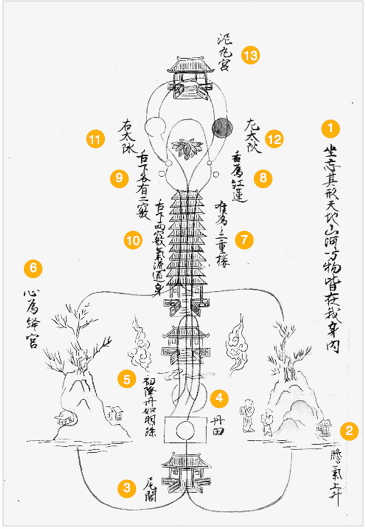
① "As I sit and forget my form (xing), all the mountains, the rivers, and the ten thousand things are within my body". The word used here for "body" is shen 身, which denotes not only the physical body, but the whole person. (See an article on the Chinese terms for "body".)
② "The Breath (qi) of the gallbladder rises above".
③ "Caudal Funnel" (weilü). Located near the coccyx, this is the first of the Three Barriers (sanguan) in the back of the body. (See an article by Wang Mu on the Three Barriers.)
④ "Cinnabar Field" (dantian). The lower Cinnabar Field is the dantian proper.
⑤ "At its first descent, the Elixir is similar to a Luminous Pearl." This sentence refers to the first stage in the formation of the Elixir, i.e., the first of the nine cycles mentioned in the title of the Chart.
⑥ "The heart is the Crimson Palace" (jianggong). The middle Cinnabar Field, commonly called Crimson Palace, is shown at the center of the picture.
⑦ "The throat is the Twelve-Storied Pavilion" (shi'er lou). This is a common name of the trachea in Neidan and meditation texts.
⑧ "The tongue is the Red Lotus" (honglian).
⑨ "Under the tongue, on each [side], there are two openings". These openings are the Cinnabar Cavities (danxue), which should be kept closed by the tongue so that the True Breath (zhenqi) does not escape.
⑩ "Through two [of the four] openings, Breath (qi) flows and pervades the body".
⑪ "On the right the Great Yin". This caption and the next one refer to the eyes. The right eye represents Great Yin.
⑫ "On the left the Great Yang". The left eye represents Great Yang.
⑬ "Palace of the Muddy Pellet" (niwan gong). The upper Cinnabar Field, commonly called Muddy Pellet.
Origins and Transmission
Although its origins and transmission require more study, the Japanese Chart appears to be closely related to a work attributed to Chen Nan (?-1213), a Neidan master who belonged to the Southern Lineage (Nanzong) of Internal Alchemy but created his own system of practice. His Cuixu pian (The Emerald Emptiness), which is part of the Xiuzhen shishu (Ten Books on the Cultivation of Reality), contains these verses:
一轉之功似寶珠,山河宇宙透靈軀。紅蓮葉下藏丹穴,赤水流通九候珠。
The result (gong) of the first cycle is similar to a Precious Pearl;
mountains, rivers, and the whole cosmos pervade the Numinous Body.
Under the petals of the Red Lotus are stored the Cinnabar Cavities;
the Vermilion River flows and pervades the Pearl of the Nine Times.
Several terms mentioned in these verses — Pearl, Lotus, mountains, rivers, Cinnabar Cavities (the “two openings” under the tongue), and Nine Times (the nine cycles of refining) — correspond to those in the captions of the picture.
© Golden Elixir Press
Picture reproduced from Katō Chie 加藤千恵, Furō fushi no shintai: Dōkyō to "tai" no shisō 不老不死の身体 — 道教と「胎」の思想 (The Ageless and Deathless Body: Taoism and the Idea of the "Embryo"), Tokyo: Taishūkan shoten, 2002, p. 121.