
Summarized from:
Fabrizio Pregadio, The Taoist Tradition: An Introduction to Teachings, Schools, and Practices
Golden Elixir Press
Current Western scholarship is virtually unanimous in asserting that there was no historical Laozi. The reputed author of the Daode jing, whose name means Old Master, can best be seen as a "collective entity" who embodies the nameless tradition — mainly oral, as far as we know — that is behind the text and the ideal of sainthood that the text describes.
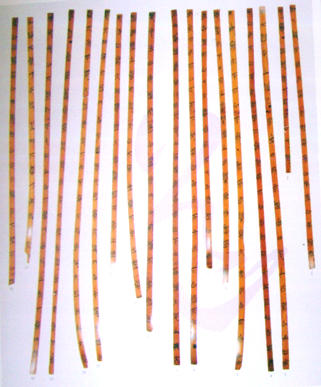
While the author and his work are traditionally dated to the 6th century BCE, the Mawangdui and Guodian manuscripts (discovered in 1972 and 1993, respectively) have helped to establish that early exemplars of the Daode jing — shorter than the current versions and different from one another — circulated by the latter half of the 4th century BCE.
It is also usually acknowledged, though, that the text incorporates earlier oral traditions. While this makes a precise dating virtually impossible, it also suggests that at first there was no "original" and "complete" exemplar of the text, which probably existed in several versions of varying content and length until, probably in the late 3rd century BCE, it was compiled in a form close to the one we know today.
Main Subjects
The Daode jing discusses three main subjects: the Dao, the saint (or the realized person), and the ruler and his government.
The Dao
Several early Chinese traditions speak of a Dao, or "Way," but the Daode jing is the earliest source that uses this word to designate the origin and source of existence. As the absolute principle, the Dao is beyond description or definition. It does not even have a name: the word dao is used only because one "is forced" to refer to it (sec. 25). Being formless, the Dao is "constant" (chang, 1), does not undergo change (41), and is "invisible," "inaudible," and "imperceptible" (14). Yet the Dao contains an "essence" (jing) that is the seed of its self-manifestation (21), which occurs without intention and through "non-doing" (wuwei; 37). The faculty through which the Dao manifests itself, and generates and nourishes the individual entities, is its de, or "virtue, power," the second term in the title of the Daode jing. Under this aspect, the Dao is called the "beginning" of the world and its "mother" (1). The two aspects of the Dao — the absolute and its manifestation as the relative — "come forth together." Their coexistence is "mystery and then again mystery" (1).
The Saint
The highest realized person in the Daode jing is the shengren, a term that, in a Taoist context, is sometimes translated as "saint" to distinguish it from the Confucian "sage." While the Confucian sage embodies the highest ethical standards of benevolence (ren) and righteousness (yi), the Taoist saint operates in the world by taking the operation of the Dao as his model: according to the Daode jing, benevolence, righteousness, and the other qualities of the Confucian sage emerge only "when the Dao is abandoned" (18).
The Taoist Tradition: An Introduction to Teachings, Schools, and Practices
A concise but comprehensive introduction to Taoist thought and religion
The Taoist saint does not act on the basis of personal interest, advantage, or desire; he does not take initiative, unless there an immediate need to do so; and he does not intend to lead others (3, 7, 22, 37, 57, 67). Instead, he is in the front by placing himself "behind," and acts only by responding to what external circumstances require. This is his "non-doing," the perfect action in which "there is no doing, yet nothing is not done" (48; the same is also said of the operation of the Dao, 37).
Ruler and Government
Although the reciprocal tasks are different, the ruler is supposed to operate in the kingdom just like the saint operates in the world. The Daode jing expresses this view in words analogous to those quoted above for the saint: "Do non-doing, and there is nothing that is not governed" (3). This involves that the ruler should issue few laws and prohibitions (57) and instead allow the people to operate by themselves (37). Since the Confucian virtues arise "when the Dao is abandoned" and "when the country is in confusion" (5, 18), the saintly ruler should not use them as principles of government.
© Golden Elixir Press