
Summarized from the Introduction of:
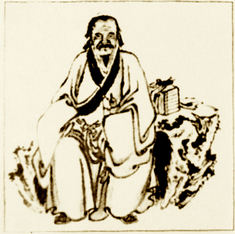
Liu Yiming 劉一明 (1734–1821) was one of the main representatives of Taoist Internal Alchemy, or Neidan. He was an 11th-generation master of one of the northern branches of the Longmen (Dragon Gate) lineage, and the author of a large number of works that present his teachings on Taoism and Neidan.
1. Life
Liu Yiming was born in 1734 in Quwo, Pingyang (in present-day Linfen, Shanxi). Before he reached the age of 20, he was severely ill three times. After recovery, he began to travel, and in 1753 or 1754 he met his first master, whom he calls the Kangu Laoren (Old Man of the Kangu Valley). In 1757, he stayed in Beijing, where he studied ophthalmology following his father's wish. Five years later, he moved to Henan, where he lived until 1765 working as a doctor.
 This page is part of a series on Liu Yiming. See the complete index.
In 1766 he resumed traveling, and around 1768 he met the Xianliu zhangren (Great Man Who Rests in Immortality), who became his main master. The Xianliu zhangren (himself an earlier disciple of the Kangu laoren) gave Liu Yiming teachings on Neidan. As Liu Yiming reports in one of his works, it was under the Xianliu zhangren that he obtained the full awakening.
After the death of his father in 1769, Liu Yiming — who was then in his mid-30s — alternated periods of traveling (in Shaanxi, Gansu, Ningxia, and elsewhere) and of seclusion for a decade. In 1779 or 1780, he visited the Qiyun mountains in Jincheng (present-day Yuzhong, Gansu) and settled there to practice self-cultivation. From that time, this mountain became his stable residence, even though he occasionally traveled elsewhere. His abode, called Zizai wo (Nest of Being by Oneself), is still extant in the present day.
Cultivating the Tao
Teachings on the principles of Taoism and Taoist Alchemy, by the great Taoist master Liu Yiming (1734–1821)
Liu Yiming devoted the second half of his life to teaching and writing. His biographies also report that he used his financial resources to restore temples, shrines, and other buildings; to buy and lease fields to poor farmers; and to provide burial ground to those who could not afford it. In 1816, he prognosticated an auspicious place for his tomb on top of the Qiyun mountains, and his "tomb cave" was built there. In 1821, on the 6th day of the 1st lunar month, Liu Yiming entered the cave, pronounced his final words to his disciples, and passed away.
Next: 2. Works ▶
© Golden Elixir Press