
Summarized from:
Fabrizio Pregadio, The Taoist Tradition: An Introduction to Teachings, Schools, and Practices
Golden Elixir Press
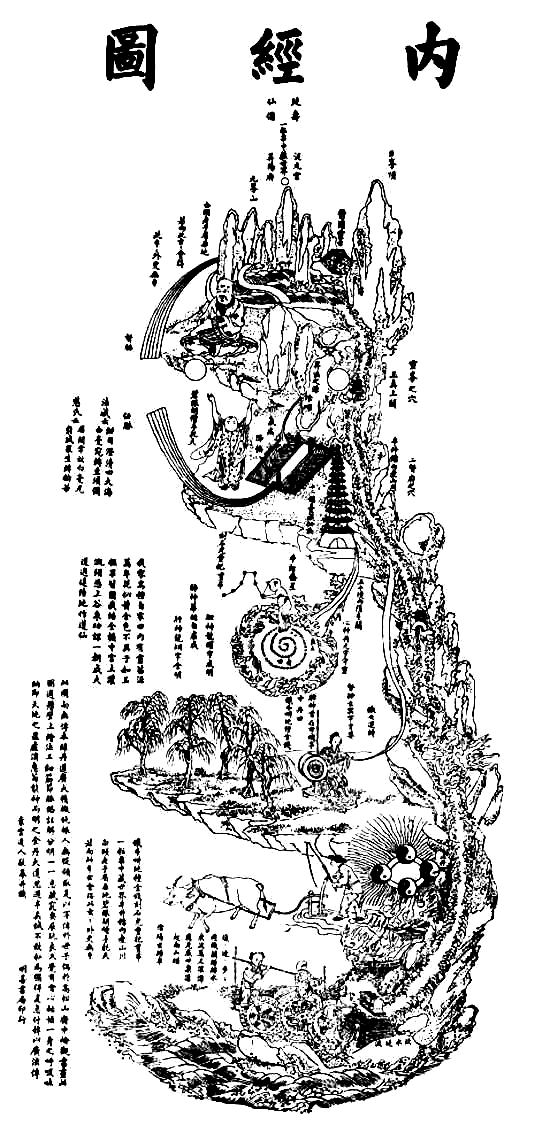
The most famous Neidan picture of the human body is the Chart of the Inner Warp (Neijing tu). Its main version is drawn on a stele, dating from 1886, now found on the walls of a building in the Abbey of the White Cloud (Baiyun Guan) in Beijing, next to the Xiuzhen tu (Chart for the Cultivation of Reality). Like other Neidan pictures of the body, the Chart of the Inner Warp should be "read" from the bottom upwards, following the sequence of the Neidan practice. The three main parts of picture, which shows a side view of the body, focus on the lower, central, and upper Cinnabar Fields.
(1) The Lower Cinnabar Field

In the lower part, a girl and a boy who represent Yin and Yang are working on a waterwheel placed at the bottom of the spine. By inverting the flow of the Essence (jing, depicted by the watercourse along the spine), they avoid that it flows downwards and is wasted. Water, i.e., the Essence, thus inverts its course and is heated by a fiery furnace near the lower Cinnabar Field, indicated by the four Yin-Yang symbols; these stand for the four external agents (Wood, Fire, Metal, Water), with the fifth one (the central Soil) represented by their conjunction. On the left of the Cinnabar Field is the “iron buffalo ploughing the earth and planting the golden coin,” an image of the first seed of the Elixir.
(2) The Middle Cinnabar Field

At the center is the middle Cinnabar Field, shaped as a spiral and located in the region of the heart. Just above it there is a child—here again, an image of the “true self”—who holds the constellation of the Northern Dipper, a symbol of the center of the cosmos. A remarkable aspect of this picture is the fact that the image of the child coincides with that of the Herd Boy. According to a famous Chinese story, the Herd Boy (corresponding to the constellation Altair) only once a year can meet and conjoin with the Weaving Girl (corresponding to Vega), who is pictured below hime.
(3) The Upper Cinnabar Field

The upper part of the picture represents the upper Cinnabar Field. Behind the mountains, on the left, the Control vessel (dumai, which runs on the back of the body) emerges; the old man sitting next to it is Laozi. Below the Control vessel, the Function vessel (renmai, which runs on the front of the body) begins; the monk standing with raised arms next to it is Bodhidharma (who, according to tradition, brought Chan Buddhism to China). The two dots stand for the eyes, and represent the Sun and Moon.
© Golden Elixir Press